

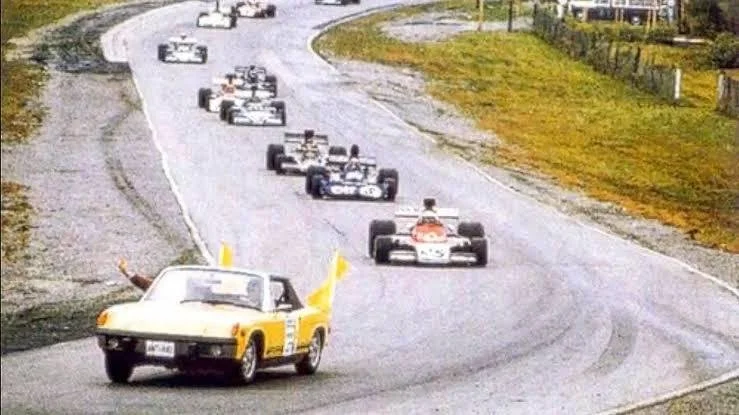
When most people think of Porsche's racing heritage and pedigree, they think of legendary endurance cars, Le Mans victories, and some of the most successful race cars ever built. But one of Porsche's most unusual contributions to racing history came from a car that was never intended to even compete in the race, yet still took part in the highest level of racing. Formula 1.
On September 23, 1973, a bright yellow Porsche 914 rolled onto the circuit at Mosport Park for the Canadian Grand Prix. What followed was a historic first for Formula 1: the little mid-engine Porsche became the first safety car ever deployed during a World Championship race. Unfortunately, the debut did not go exactly as planned. What was supposed to bring order to an otherwise chaotic race instead created so much confusion that officials struggled to determine who had actually won.
Formula 1 in 1973: A Different Era of Racing
To understand why the Porsche 914's appearance mattered, it helps to know what Formula 1 looked like in the early 1970s. Racing was considerably more dangerous than it is today. Tracks often had limited runoff areas, basic barriers, and far fewer safety systems. When a car crashed or stopped on the circuit, marshals frequently had to recover it while the race continued around them.
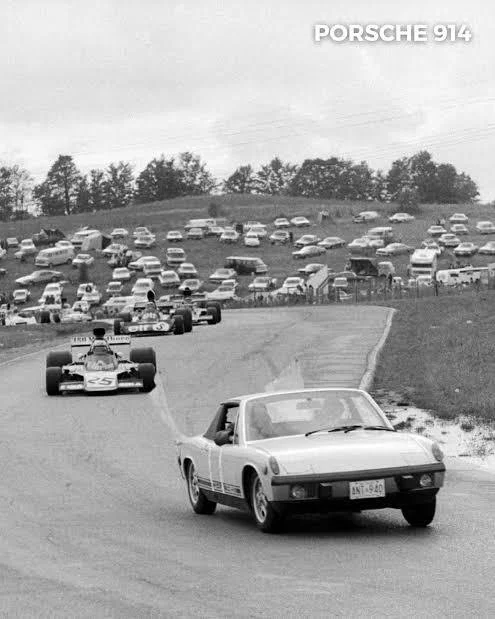
Modern safety procedures were still developing, and the concept of bringing the entire field under control behind a dedicated safety car was relatively new to Formula 1. The Canadian Grand Prix was held at Mosport Park in Ontario, a fast and challenging circuit known for its elevation changes and demanding corners.
The September race became particularly difficult because heavy rain left the track soaked. Swedish driver Ronnie Peterson qualified on pole position, but the weather quickly became the biggest factor in the race. Drivers struggled with poor visibility and changing grip as the circuit gradually dried. Those changing conditions created another problem. Teams began bringing cars into the pits to switch from wet-weather tires to slicks, something that was much less common in Formula 1 at the time. With cars entering and exiting the pits at different intervals, the running order became increasingly difficult to follow.
The Crash That Changed Formula 1
Around lap 32, disaster struck when Jody Scheckter's McLaren collided with François Cevert's Tyrrell. Both cars were eliminated from the race, and the resulting accident left a dangerous situation on the circuit. Recovery crews needed time to remove the damaged vehicles and debris, but the race was still underway.
Rather than letting the field continue at full speed through the incident area, officials decided to try something not previously used during a Formula 1 World Championship race. They deployed a safety car.
The concept had been tested at the Austrian Grand Prix circuit earlier that year, but Mosport would be the first to deploy it in a real race. The vehicle chosen for the job was that very bright yellow Porsche 914, driven by Canadian racer Egbert "Eppie" Wietzes, who had previously competed in Formula 1. Suddenly, one of Porsche's most affordable sports cars was leading some of the fastest racing machines in the world.
Enter the Yellow Porsche 914
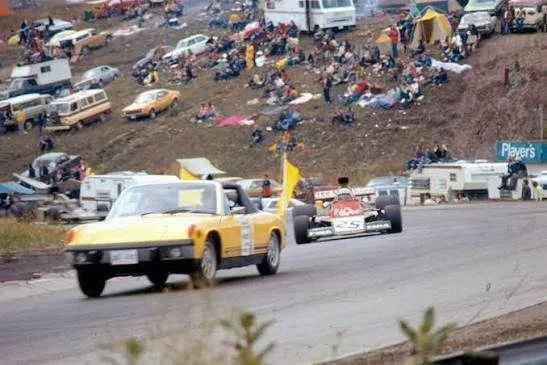
The choice of a Porsche 914 might seem unusual today, especially considering the powerful performance cars used as modern Formula 1 safety vehicles. But as a relatively new design and a newcomer to the North American market, it was the perfect opportunity to showcase what it could do.
The job was simple in theory. The Porsche would enter the track ahead of the race leader, slow the field, and keep the cars together while officials cleared the accident. Unfortunately, identifying the race leader was proving almost impossible.
The Mistake That Turned the Race Upside Down
By the time the Porsche 914 entered the circuit, the combination of changing weather and unexpected pit stops had already made the race difficult to score. Unlike modern Formula 1, which uses electronic timing systems to monitor every car, officials in 1973 relied heavily on handwritten lap charts. Each time a driver completed a lap, the timing crews had to record the information manually. With drivers constantly changing positions through pit stops, the system struggled to keep up.
When Wietzes brought the Porsche onto the track, officials mistakenly positioned him ahead of Howden Ganley rather than the actual leader. That single decision changed the race. Several drivers were allowed to continue around the circuit ahead of the safety car before eventually joining the back of the queue. In the process, some effectively gained a lap on their competitors.
Peter Revson, driving for McLaren, was among those who benefited from the confusion. Other drivers found themselves trapped behind the Porsche while their competitors gained ground. Instead of bringing everyone back onto equal terms, the safety car had unintentionally reshuffled the race. When the Porsche eventually returned to the pits, the drivers resumed racing, but nobody clearly understood who was actually leading.
The Grand Prix Nobody Knew Who Won
The confusion continued all the way to the finish. Emerson Fittipaldi believed he had won the race, and his Lotus team appeared to agree. Team owner Colin Chapman even began celebrating as Fittipaldi crossed the finish line. Other teams interpreted the running order completely differently. Jackie Oliver believed he had a legitimate claim to victory, while Howden Ganley had also been caught up in the confusion the safety car created. Meanwhile, Peter Revson had quietly put himself into contention for the win.
With the race complete, officials compared lap charts and reviewed the scoring records to determine the actual finishing order. After hours of deliberation, Revson was officially declared the winner in his McLaren, with Fittipaldi finishing second and Oliver third. The race became known as the "Confusion Grand Prix," and the Porsche 914's first appearance as a safety car became an unforgettable part of Formula 1 history. For Revson, the victory was especially significant. It would be his final Formula 1 win before his death during testing in March 1974.
How the Porsche 914 Helped Change Formula 1
Although the first deployment was anything but smooth, the idea behind the safety car was an important step forward. The incident demonstrated that bringing the field under control could provide a safer environment for marshals and recovery crews. It also exposed the importance of clear procedures, accurate timing, and correctly identifying the race leader.
Formula 1 did not immediately adopt the safety car as a regular feature. Various safety vehicles appeared at selected events over the following years, but it was not until 1993 that the safety car became an officially established part of Grand Prix racing. Since then, the system has become one of the most recognizable safety procedures in modern motorsport.
Today's safety cars are sophisticated performance machines supported by race control communications and electronic timing systems. Their deployment can completely change race strategy, close gaps between competitors, and help protect drivers and track workers. The modern system differs greatly from the one used in 1973, but its history still traces back to that little yellow Porsche 914 at Mosport.
An Unexpected Chapter in Porsche 914 History
The 914 has no shortage of interesting motorsport stories. From the success of the 914/6 GT at Le Mans to its appearances in endurance racing and rally competition, the platform has repeatedly demonstrated that it deserves more respect than its original entry-level reputation suggested.
Its role in the 1973 Canadian Grand Prix adds another unusual chapter to that history. For a car that was often dismissed as the oddball of the Porsche lineup, the 914 managed to leave its mark on one of the most prestigious racing championships in the world without ever entering the race as a competitor.
Visit Our Porsche 914 Shop — Just Over an Hour from Salem
Martin Mid Engine
📍 25858 S Elwood Rd, Colton, OR 97017
🕘 Mon–Fri, 9am–5pm
Just northeast of Salem via OR-214 through Silverton. If you're serious about fixing your 914’s rust the right way, we're worth the drive.
Get Your Porsche 914 Repair Quote
Saving a 914 or bringing a full restoration to life requires solid metal and a dependable drivetrain. Share the issues you are facing, and we will provide a straightforward evaluation alongside an actionable plan to resolve them.